
Skills transfer, in a plant or workshop, is how an expert’s know-how passes to colleagues: the gestures, but also the reasons behind them, the cues to watch for and the exceptions. For a long time, the answer was the written procedure. It is still useful, but it is no longer enough. It captures the “what” and leaves out most of what makes a gesture right. Here is why, and what works better.
What a written procedure captures, and what it misses
A written procedure captures the sequence of steps, rarely the reasoning that connects them. It says “tighten to this torque,” “check the alignment,” “replace the part.” That is the “what,” and it matters.
What it misses is everything the expert does without thinking:
- The why: the reason behind a step, which lets you adapt when a situation falls outside the usual.
- The cues the expert watches for: a sound, a vibration, the color of a weld, a smell. They spot these without ever having written them down.
- The exceptions: the machine that behaves differently after a changeover, the part from one supplier that needs a specific setting.
- The gesture itself: the angle, the pressure, the rhythm. A sentence is a poor way to describe a hand movement.
That is why a new hire, procedure in hand, still depends on an experienced colleague. The document says what to do; the colleague shows how to do it well.
Why long procedures rarely get written or kept up to date
Detailed procedures are rare because they are expensive to produce. Three obstacles show up in almost every workshop.
The time it takes to formalize
Writing a complete operating procedure means sitting down, away from the machine, and turning hands-on know-how into text. The experts, the people who actually know, are also the ones with the least time. Mickaël Dran, CEO of Le Garrec, puts it this way: “When you have to describe everything, step by step, teams realize how complex their work really is.”
The layout
A Word document or a quality template imposes its own format: headings, tables, numbering, screenshots pasted in by hand. That formatting work passes on nothing extra, but it takes time.
Approval cycles
A procedure often goes through several rounds of review before it is released. The result: by the time it is finally published, the process may already have changed. And since updates follow the same route, they get postponed.
Why documents are hard to find at the workstation
Even when the procedure exists, it is not where it is needed. It sits in a binder, a shared folder or a document management system, filed according to a logic that is not the technician’s logic when facing a breakdown.
At the workstation, the question is concrete: “the machine is showing this fault, what do I do?” Finding the right file, opening it on an office screen, scrolling through twenty pages: nobody does that with their hands inside the machine. They call a colleague, or they improvise.
What works better for skills transfer
What works better is capturing know-how where it is used, then structuring it and making it findable in seconds. That is the approach behind Shiroo, in four steps.
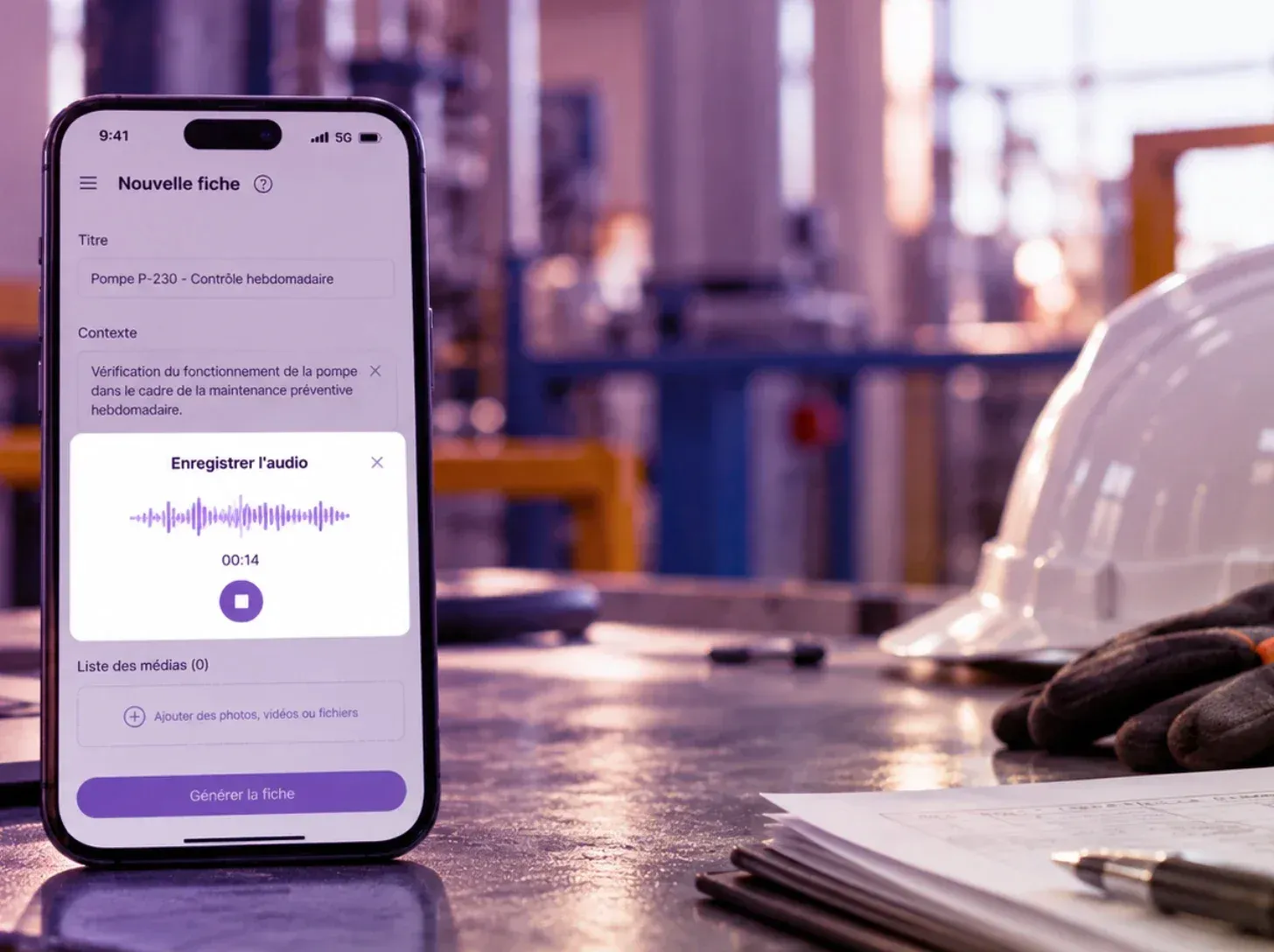
- Capture at the machine, by voice or video. The technician explains the gesture out loud, in front of the equipment, with photos or video as needed. They talk the way they would explain it to a colleague, with no writing involved.
- Structure it into a knowledge sheet. Shiroo turns it into a clear sheet: symptom, steps in order, point of caution, video or photos. Layout is no longer a chore.
- Have a subject-matter referent approve it. A referent reviews and approves the sheet. Quality stays under control, without an endless review loop.
- Find it in plain language. The whole team asks questions in their own words, including by voice, from a phone, tablet or computer. The answer cites the original sheet, so everyone knows where the information comes from and who approved it.
Existing procedures are not lost: PDFs (procedures, manuals) can be imported and become searchable the same way.
Classic written procedure vs knowledge sheet captured on the shop floor
| Criterion | Classic written procedure | Knowledge sheet captured on the shop floor |
|---|---|---|
| What gets passed on | The steps (the “what”) | The steps, the why, the cues to watch for, the point of caution |
| Who produces it | A writer, or an expert away from the machine | The expert, in front of the machine |
| Format | Text and tables, laid out by hand | Spoken explanation, photos, video, structured automatically |
| The gesture | Described in words | Shown on video |
| Approval | Often a long review cycle | Reviewed and approved by a subject-matter referent |
| Access at the workstation | Binder, shared folder, document management system | Plain-language question, by voice, on a phone or tablet |
| Updates | Rare, because they are costly | A new explanation is enough |
Two real-world examples
PEPIN: 5 minutes instead of 30
At PEPIN, a high-precision machining specialist, a procedure is now formalized in 5 minutes instead of 30. The team shares a common knowledge base that can be queried in real time, and new hires become autonomous faster. Matthieu Fraix-Bavu, maintenance industrialization referent: “We don’t just store information, we bring it to life.”
Le Garrec: operating procedures written by the people who build
Le Garrec, a stainless steel fabrication shop in Pontivy, France, used to pass on 40 years of know-how by word of mouth. The company now documents the forming, assembly and welding procedures for 4 tank models. Four experts create the knowledge sheets on the shop floor, approved by management, with 1 hour every Monday set aside to plan the sheets to produce. The know-how is formalized by the people who hold it, not pieced together after the fact.
Where to start
There is no need to document everything at once. Start with the most frequent tasks, the ones few people master, the ones where a mistake is costly, and the ones at risk from an upcoming departure. One hour a week, as at Le Garrec, is enough to set the pace. Our deployment method walks through this prioritization.
See skills transfer at work in your shop
The written procedure keeps its place, but shop-floor training now runs on what the expert shows and says in front of the machine. To see how your technicians can capture their gestures in minutes and make them available to the whole team, book a Shiroo demo.