In a manufacturing environment that never stops changing, knowledge transfer is no longer optional. It is a necessity. As technology advances, generations succeed one another and jobs evolve, a company’s ability to preserve, share and manage its skills becomes a strategic lever.
Passing on knowledge is not just about training a new hire. It is also about securing processes, building on field experience and keeping operations running. The need is even greater in manufacturing, where losing a single technique or piece of technical expertise can slow down an entire production line.
Knowledge transfer: definitions and types in an industrial context
Passing on knowledge is more than transferring information. In a company, and even more so in manufacturing, it means capturing, structuring and keeping alive a body of knowledge, experience and hands-on techniques. To understand what is at stake, start with clear definitions and the different types of knowledge involved.
What is knowledge transfer?
Knowledge transfer is every means an organization uses to share, spread or preserve the knowledge its operations depend on. It can be spoken or written, formal or informal.
It includes:
- passing on know-how: technical or practical skills learned through experience;
- passing on professional conduct: workplace attitudes, company culture and expected behavior;
- knowledge transfer in the broader sense, often used in knowledge capture or internal training initiatives.
In practice, transfer often goes beyond tools and manuals. It relies on human exchanges, observation on the shop floor and precise descriptions of hands-on techniques. That is its strength, and also its weakness.
Explicit and tacit knowledge
In manufacturing, not all knowledge takes the same form or travels as easily. There are two broad families. On one side, explicit knowledge, which can be written down without much difficulty: procedures, instructions, work instructions, safety sheets. This content is written, shared and archived.
On the other, tacit knowledge, learned through experience, observation and trial and error. It is not always easy to put into words, because it comes from feel, intuition and a technique refined over years. In manufacturing, the two overlap constantly. An operator does not just follow a technical sheet: they know when to adjust, notice a sound, feel an unusual vibration. That ability to anticipate is where much of the job’s value lies.
Knowledge can also be grouped by use. Some is technical: running a machine, setting up tooling, reading a diagram. Some is organizational: understanding how a production line fits together or meeting a workshop’s quality requirements.
Finally, there is knowledge that comes from lived experience: learning from an incident, building on an improvement made on the floor, sharing what was learned after a breakdown.
Together, this knowledge is the invisible foundation of performance. When it is not passed on, it fades. And sometimes it disappears with the people who patiently built it.
Why pass on knowledge in manufacturing?
In manufacturing, knowledge transfer is not just an HR topic. It is a strategic lever. Many jobs rely on technical skills built over time and sometimes hard to document. Some techniques and settings appear in no documentation, yet they are essential to running a workshop or a process.
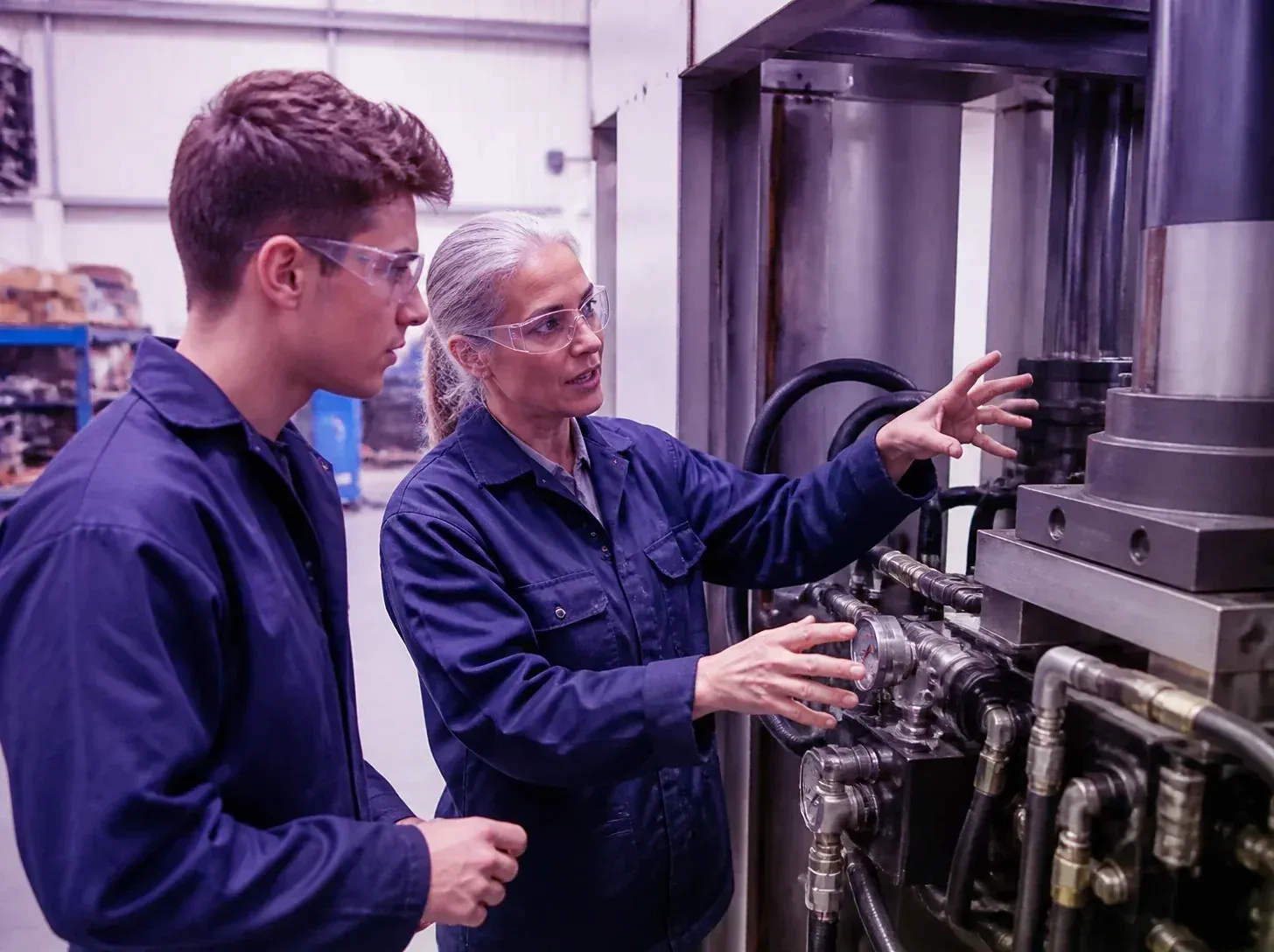
The shop floor brings its own challenges. When an expert is about to leave and no successor is ready, the company risks losing valuable capital. When a young employee joins a team without the right reflexes yet, all the informal transfer is put to the test. Add the digitization of workstations, which changes the tools people use and demands more clarity and method in how knowledge is shared.
The pace of change does not help. Standards evolve, technologies change and knowledge itself keeps moving. Without organized transfer, it becomes hard to maintain quality, ensure continuity or even innovate.
In this context, learning on the job is no longer enough. Knowledge has to be structured, its flow treated as a process in its own right, and supported by tools that make it accessible, understandable and alive every day.
Why knowledge transfer is strategic in manufacturing
Passing on knowledge is not only about repeating what already exists. It is also how a company evolves, stays competitive and prepares for the future. In an industry defined by technical trades, strict standards and a constant need for agility, knowledge transfer becomes a strategic pillar.
Preserving expertise through departures, turnover and automation
In many industries, much of the expertise rests on experienced employees. When they leave, their knowledge leaves with them, unless its transfer was planned. An unprepared departure can create operational strain, errors and even lost productivity.
Turnover increases the risk. New hires have to adapt quickly, often without access to the experience of the people they replace. And when automation takes over, human knowledge still has to be available to supervise, adjust or step in when needed.
Keeping job expertise alive, documented and transferable secures critical knowledge while keeping control over how it evolves.
Training teams faster and better
Knowledge transfer also shortens training time. The clearer, more structured and more accessible knowledge is, the easier it is for a new employee to absorb. It is a direct lever for successful onboarding.
The impact on quality and safety is significant. A poorly passed-on instruction or a misunderstood technique can have serious consequences for production or for people. Passing on knowledge is also about protection: processes are followed, best practices spread and mistakes avoided.
Documenting knowledge does not hold back agility. On the contrary, it aligns teams on a common foundation while leaving room for individual growth.
Driving innovation and continuous improvement through sharing across generations
Sharing knowledge does not mean freezing it. It is also how knowledge evolves. A company that encourages dialogue between generations stimulates new ideas, better practices and fresh questions about old routines.
Younger employees bring a new perspective. Experienced ones share solid reference points. Together, they enrich each other’s approaches. That dynamic fuels continuous improvement, adoption of new tools and the ability to innovate.
Information flow in the workplace then becomes a virtuous circle: by teaching, we learn. And by learning, we teach better.
The learning organization: a new model for industrial performance
As manufacturing keeps changing, more and more organizations are becoming learning organizations. They put learning at the core of how they operate, valuing both their teams’ experience and new knowledge. The model rests on a culture of sharing, where everyone is encouraged to pass on what they know without fear of losing their value.
It also means setting aside time for knowledge transfer: mentoring, continuing education, informal and peer-to-peer exchanges. These practices only work when backed by the right tools, ones that support a collective effort. Knowledge is then no longer frozen: it flows, changes, adapts to shop-floor constraints and fuels continuous improvement.
Knowledge becomes a strategic asset in its own right, just like machines or software. That is exactly where AI fits in. It does not replace people, but supports knowledge management by making it easier to structure, update and share at the right time.
Digitizing knowledge transfer: AI and the Shiroo use case
Facing the challenges of knowledge transfer in manufacturing, digital tools offer new possibilities. The goal is no longer just to preserve what exists, but to make it easier to access, update and use every day. That is where platforms like Shiroo come in.
How does knowledge transfer happen today?
In many manufacturing companies, knowledge transfer still relies on informal methods: watching on the shop floor, improvised mentoring, verbal instructions. These approaches have their merits, but also their limits.
There is often not enough time to train properly. Teams are under pressure, resources are limited and mental load is high. Knowledge is scattered across documents, emails and shared files, hard to find at the right moment.
In this context, even the most valuable expertise can stay invisible or out of reach. Without clear organization, it is hard to build on collective experience.
Structuring knowledge with AI: identify, capture, prioritize
AI now makes it possible to take a real step forward. It does not replace people, but helps them better organize what already exists.
In practice, an AI-supported approach lets you:
- identify critical knowledge, often tacit or undocumented;
- capture it easily, out loud or on video, then automatically structure it into clear knowledge sheets;
- prioritize content by how often it is used, how critical it is or how likely it is to disappear.
The result is a solid, clear base that keeps growing. Information no longer gets lost in forgotten folders: it is connected, structured and ready to use.
Getting knowledge to the right person at the right time
Digitization is not just about storing knowledge. It is about keeping it alive and making it available wherever the need arises.
Take an example: an operator is working on a machine they do not know perfectly. With Shiroo, they ask a question from their phone and get the procedure, the explainer video or the validated lesson learned in seconds, without leaving their workstation. More use cases are available on our website.
Information becomes available in real working conditions, without searching. That prevents mistakes, makes interventions safer and builds team autonomy.
Passing on knowledge to help manufacturing grow
In manufacturing, knowledge transfer is not just about preserving the past. It is a living, forward-looking effort. It secures skills, speeds up autonomy and spreads expertise across teams.
What we learn, what we do, what we know: all of it is worth sharing, as long as the right conditions are in place. That is where digital tools and AI open new possibilities, by structuring knowledge better and making it available when it is needed.
Solutions like Shiroo turn knowledge management into a lever for performance and cohesion. And when every skill counts, the ability to keep knowledge alive and moving becomes a real strategic advantage.
Ready to get started? Request a demo to talk through your knowledge transfer challenges.