
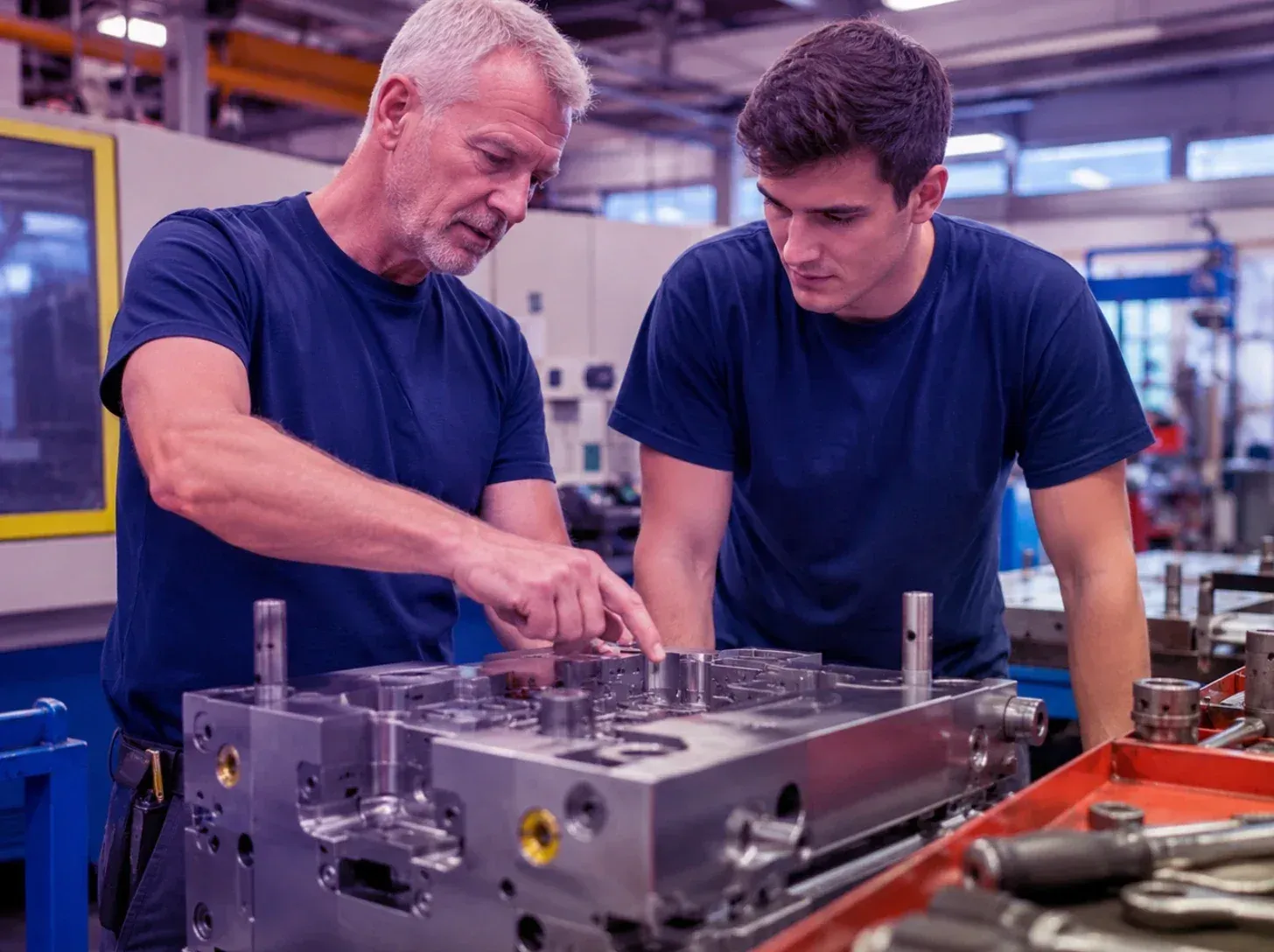
Manufacturing never stands still, and passing on knowledge is key: it keeps operations running, helps teams build skills and drives continuous improvement, while adding lasting value to the business. With many experts retiring, a shrinking pool of young talent and new technologies arriving, manufacturers need effective strategies to preserve and share what they know. This article covers the challenges of knowledge transfer in manufacturing, the traditional methods and what technology, AI in particular, brings.
What does knowledge transfer mean in manufacturing?
Knowledge transfer covers the processes and practices used to capture, document and share what an organization’s people know. It has three dimensions:
- Theoretical knowledge: the core principles, standards and regulations of the industry.
- Know-how: the technical and practical skills needed to carry out specific tasks.
- Organizational knowledge: ways of working, internal processes and best practices.
Done well, it limits the loss of expertise, cuts errors and makes teams more responsive when something goes wrong.
The challenges of knowledge transfer in manufacturing
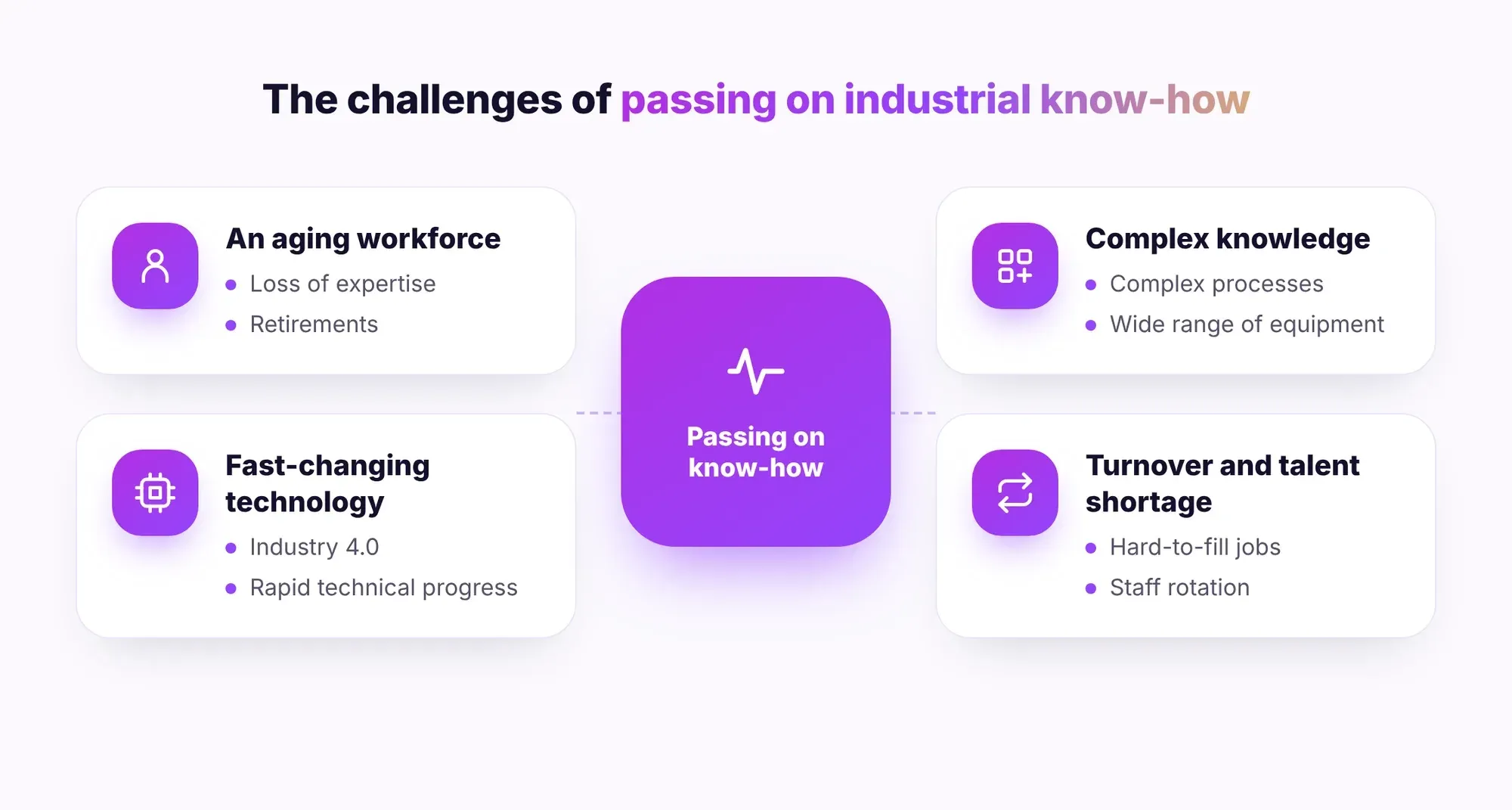
1. An aging workforce and lost expertise
Manufacturing has an aging workforce, and more and more experts are retiring. It is one of the hardest-hit sectors, as a study by the DREETS Bourgogne-Franche-Comté shows.
Older workers make up a growing share of France’s labor force, and hundreds of thousands of people retire every year, according to the DREES annual overview. Meanwhile, a study published in the Revue Économie, Gestion et Société suggests that most of a company’s know-how, up to 80%, is tacit. Without the right strategy, every departure takes knowledge with it, and productivity and quality suffer.
2. Complex, varied knowledge
Industrial environments combine complex processes, strict regulations and a wide range of equipment and technologies. Passing on this knowledge takes rigorous structure and has to fit each employee’s level.
On top of that, according to an analysis published by GPO Magazine, existing vocational programs would cover only about half of the hiring needs for some jobs through 2030.
3. Turnover and a shortage of skilled workers
Manufacturers struggle to hire and keep talent. An Insee study shows that a large share of French manufacturers report hiring difficulties. Poorly organized knowledge transfer slows down onboarding and drags on overall performance.
Monster’s Future of Work 2024 study ranks manufacturing among the hardest sectors to hire in, especially for skilled engineering, production and maintenance profiles. Add high turnover, and the whole industry has a real problem.
4. Fast-changing technology
With Industry 4.0, production tools and methods change quickly. Companies need their people to stay current and make the most of new technology. Over the past decade, progress has accelerated with AI, augmented and virtual reality, digital twins and IoT.
Classic strategies for passing on knowledge
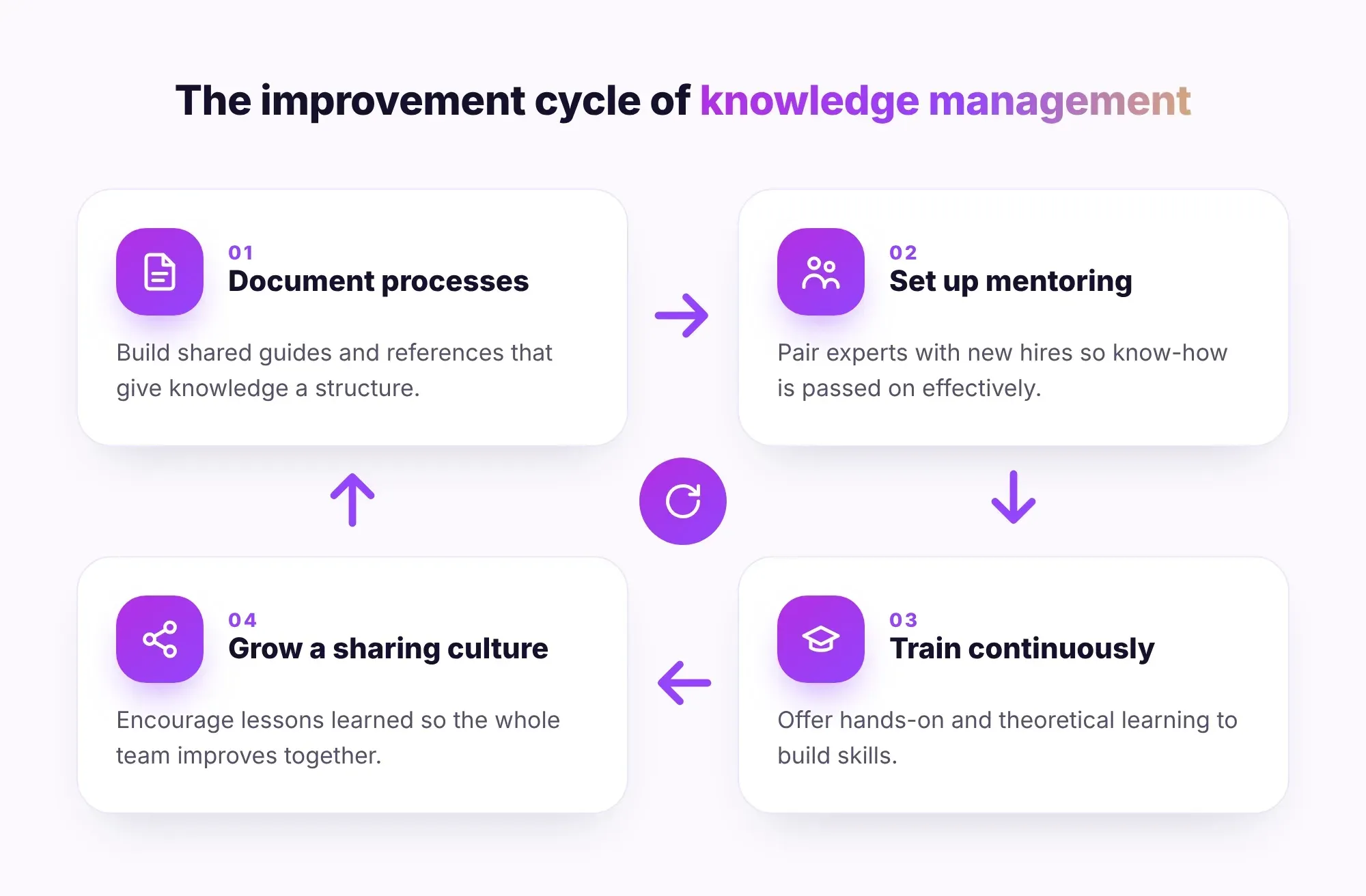
1. Document and standardize processes
- Create guides, manuals, templates and standard operating procedures to structure knowledge. They guide experts and make documentation easier.
- Use a central knowledge base everyone can access: knowledge only helps if it is shared.
- Set up a document management system to organize and update information.
If one company sets the standard here, it is Toyota. Having invented the Toyota Production System and just-in-time manufacturing, the Japanese automaker is also a benchmark for passing on know-how.
2. Mentoring and coaching
- Pair experts with new hires, the traditional apprenticeship model.
- Run training on the shop floor for hands-on, on-the-job learning.
- Encourage regular exchanges between teams to surface roadblocks and spread best practices.
French company ACMAT relies on mentoring to secure its know-how as its workforce ages. Coaching passes on company-specific processes and procedures, while mentoring supports broader professional and personal development.
There is also reverse mentoring, where younger employees train senior colleagues, especially on digital tools. Companies such as BNP Paribas and Sanofi use it.
3. Continuous training and blended learning
- Offer theoretical and hands-on training that fits employees’ needs: learning, then doing, is the best way to make knowledge stick.
- Use e-learning platforms to build training paths and reinforce learning.
- Combine in-person sessions with online modules to fit everyone’s workload. Digital training also reaches those who could not attend.
Assystem, an international engineering company, put blended learning at the heart of its training strategy. The company reports that this built a learning culture across its subsidiaries and reached an 89% completion rate, a sign of strong employee engagement.
4. A culture of knowledge sharing
- Reward in-house experts who share what they know, financially or otherwise: a lot of knowledge stays hidden for fear of losing a unique edge.
- Set up working groups that mix senior and junior staff on the same tasks to compare best practices.
- Hold lessons-learned sessions after key projects to spread what the team learned.
TEXELIS, a 280-person company, is a good example. Some operations had to stop while the technician in charge of machine repairs was on extended leave, which showed how much skills transfer within the team mattered.
After that experience, TEXELIS launched a dedicated knowledge transfer program. It appointed a program lead and involved its managers, seen as key players. First focused on people close to retirement, the program expanded to administrative, management and support roles, starting with unique skills held by a single employee.
What AI and modern tools bring
AI and new technologies offer practical ways to improve knowledge transfer in manufacturing.
1. AI to document, structure and share knowledge
AI makes knowledge capture easier. Speech-to-text and video analysis let experts put their expertise into words: they simply show what they do or explain it out loud, naturally, and the AI writes it up. Building and growing a knowledge base becomes simple. Tools such as Intalio, Slite and Trainual address this use.
2. AI to use knowledge bases
Conversational assistants then put those knowledge bases to work. They answer employees’ questions instantly and cut search time. With AI search, people no longer look for a file, but for a specific piece of information inside the documents. Ask for the Moon, Jask and Elium offer this kind of use.
3. Augmented reality and immersive training
Close cousins of AI, augmented and virtual reality offer immersive learning. They help employees build skills in context and understand complex processes. Their strength is to deliver expertise in the exact context of a real work situation. Tools such as Picomto and Innoteo’s Dimeo stand out here.
4. Shiroo, built for the shop floor
Shiroo brings capture and lookup together in a single app designed for manufacturing. Experts digitize their know-how by explaining it out loud, taking photos or filming a task as they do it. Shiroo turns it into a clear, illustrated work sheet, which a subject-matter lead reviews and approves before it is published.
Anyone who needs information then asks their question in their own words. The assistant searches the company’s approved content and gives an answer with its sources.
And Shiroo works on the job, on phone, tablet or computer: the information is there right when it is needed. See Shiroo’s use cases.
Conclusion
Passing on know-how is a major issue for manufacturing: it keeps expertise alive and companies performing. Facing an aging workforce, fast-changing technology and turnover, manufacturers need strategies that combine documentation, training and a culture of sharing. AI and tools like Shiroo offer practical ways to structure and share knowledge, for a more agile and competitive industry. Request a demo to see it on your own use cases.