
Why know-how matters
In an increasingly competitive and constantly changing environment, companies have to innovate, keep adapting and make the most of their internal resources to stay competitive.
Among those resources, employees’ know-how is central. Know-how, which spans technical skills, business processes and years of accumulated experience, is an organization’s DNA: what makes it unique and different from everyone else. Yet many companies still neglect knowledge management. This intangible capital is often scattered or underused, and it can erode, taking performance down with it.
Managing knowledge, and know-how more broadly, is a direct answer to that problem. It means documenting and structuring the knowledge specific to a company, sharing it across teams and preserving it so it can be passed on over time. Good know-how management does more than protect the past: it also fuels innovation and the company’s ability to adapt. The goal is to make knowledge a driver of collective performance, essential to continuous improvement and long-term competitiveness. So how do you organize it, and with which tools? That is what this article explores.
Defining know-how management
The Larousse dictionary defines know-how as “a skill acquired through experience with practical problems, in the practice of a trade.”
To add some nuance, know-how can be seen as the practices, methods and skills, technical or not, specific to an individual, a team or an organization. It comes from learning, accumulated experience and adapting to real-world conditions, which makes it hard to acquire any other way than through experience. For a company, know-how is a real competitive advantage: it sets the company apart and sustains a high level of performance.
That only works if the company can capture, structure and share this know-how. The problem is that it is often hard to capture and document. Much of what employees know stays implicit, or tacit: undocumented and therefore hard to pass on. Know-how management aims to turn tacit knowledge into explicit knowledge. That can mean documenting internal procedures, building shared knowledge bases, setting up mentoring or using specialized digital tools.
Managing know-how also protects skills continuity at a time when retirements and staff turnover threaten knowledge transfer. It improves coordination between teams and speeds up learning for new hires.
Know-how management: challenges and solutions
Despite its importance, managing knowledge and know-how raises several challenges, whatever the industry or the trades involved. Here are the most common obstacles.
- Scattered knowledge: know-how can be spread across different teams or departments, which makes information hard for everyone to access. Without excellent communication, getting to the know-how becomes very complicated.
- Knowledge hoarding: a fairly common human reflex. Some experts do not want to share what they know, because it is what makes them valuable today. That is a real risk for the company now, since performance stays below its potential, and above all later: when someone who holds back their knowledge leaves, part of the organization’s know-how leaves with them. Work can slow down or even stop, or it takes a major effort to rebuild what was lost.
- Keeping it current: know-how changes fast, with new technology, new work methods and day-to-day experience. As a famous Albert put it, “When you stop learning, you start dying.” Knowledge has to be kept up to date, and the company’s knowledge base has to keep growing so it reflects what really happens in the field.
- Lack of documentation: this is the main obstacle. Documenting and structuring know-how is demanding mental work: you have to put into words knowledge, methods and techniques you are often only partly aware of. It takes perspective and, above all, time. And experts are usually the busiest people in the company, so they do not have that time.
These are big challenges, and most of them are timeless. Fortunately, several solutions exist today.
- Documenting knowledge: capturing and documenting the company’s critical processes is essential, in manuals, practical guides or knowledge bases. As logical and necessary as this is, it asks a lot of experts, who would usually rather do their job than write procedures. Many senior experts are also not very comfortable in front of a computer.
- Mentoring and apprenticeships: encouraging experienced employees to train new hires and apprentices, or to share their expertise with their team, passes knowledge on naturally. But it runs into cognitive limits: we do not all retain information the same way.
- Knowledge management tools: since the first two solutions only go so far, many specialized tools have emerged. Digital tools such as Shiroo, Document360 or Intalio help structure, centralize and organize knowledge and make it available to every employee.
What digital tools like Shiroo bring
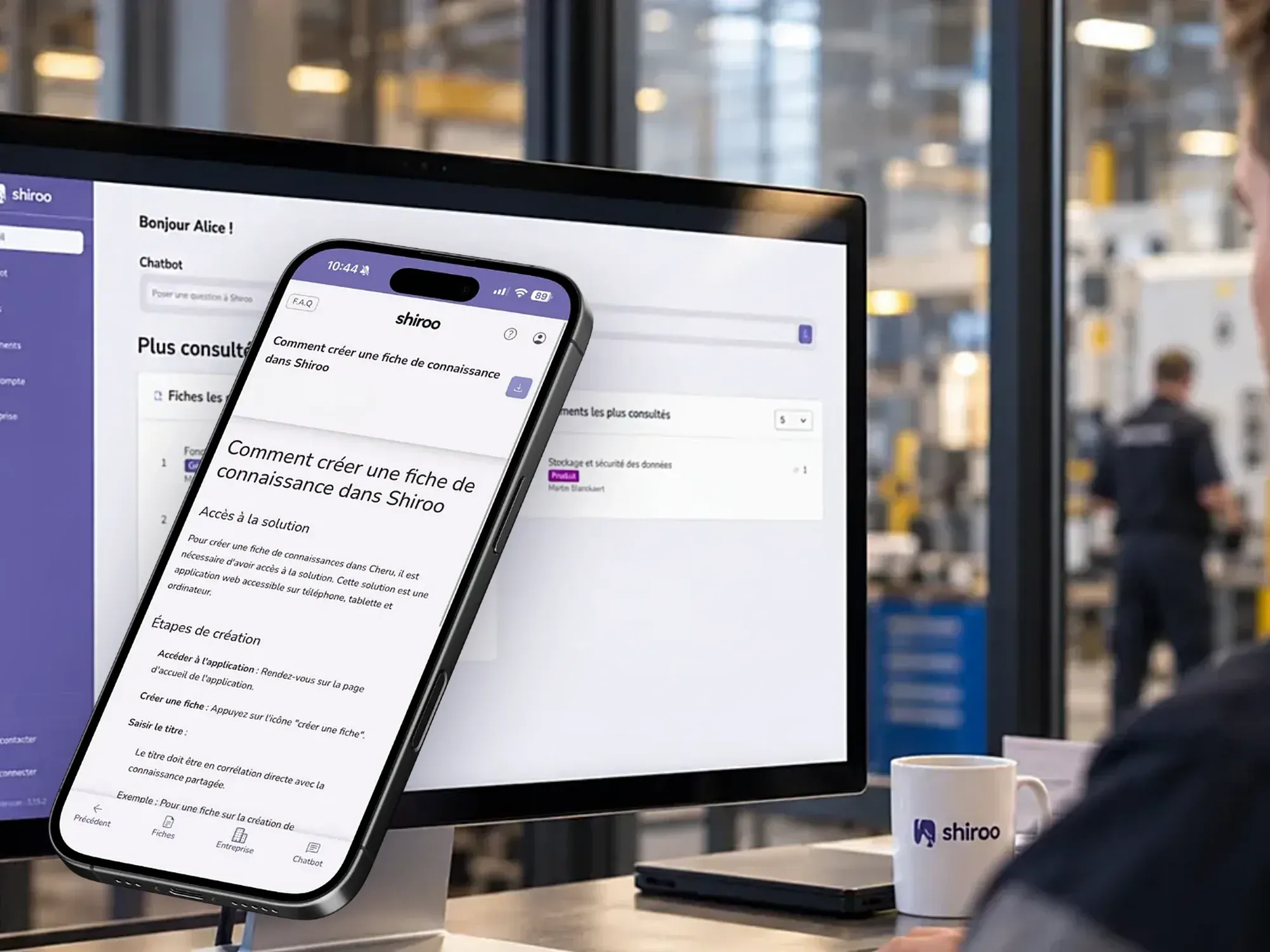
These tools have changed the way companies manage their knowledge and know-how. Shiroo stands out for how easily it captures knowledge and structures information automatically.
Shiroo addresses several know-how management challenges:
- Automated capture and structuring: the most common obstacle is how hard it is to capture and structure know-how. With Shiroo, it becomes as simple as explaining something to a coworker. The expert explains the task out loud, takes a photo or films it on their phone, and Shiroo’s AI turns it into a clear, structured knowledge sheet.
- Validated knowledge: every sheet is reviewed and approved by a subject-matter referent before it is published, so the team knows what it reads is reliable.
- Centralized knowledge: procedures, best practices and technical know-how sit in a single platform, alongside the company’s existing documents. Knowledge stops being scattered and stays available.
- Mobility: many people work in the field, away from a screen, yet most company knowledge can only be reached from a computer. Shiroo works on phones, tablets and computers: people ask their question in their own words and get a sourced answer right where they work.
- Easy updates: a sheet is simple to edit and expand, so know-how keeps pace with what happens in the field and does not go stale.
- Stronger collaboration: everyone can contribute and add to their coworkers’ knowledge, which builds an environment that supports continuous improvement.
Tools like Shiroo do more than manage knowledge. They support change management and innovation, and strengthen company culture by building a community of employees invested in continuously improving their practices.
Conclusion: making the most of your knowledge capital
Managing know-how is now a strategic lever for any company that wants to stay competitive and agile in a complex environment. Far from being an administrative chore, it becomes a management and innovation tool that improves both operational efficiency and employee engagement.
Tools like Shiroo make this easier and more accessible by capturing and structuring knowledge simply and collaboratively. They help preserve, share and evolve know-how, ensuring skills continuity and agility as the market changes.
By managing know-how proactively, companies avoid losing critical skills and strengthen their ability to innovate and their long-term resilience. In a world where information has become a currency, making the most of your knowledge capital is more than ever an investment in the future.