
Manufacturing keeps changing, and knowledge management has become a major issue for companies that want to raise productivity, stay competitive and last.
Passing on know-how, capturing expertise, getting to the right information fast: manufacturers face real challenges here. Yet good knowledge management cuts errors, improves decisions and speeds up innovation.
This article looks at the stakes, the challenges and the key strategies for managing knowledge on the shop floor, and at what new technologies, AI in particular, bring to the table.
What is knowledge management?
Knowledge management is the set of processes, methods and tools an organization uses to collect, organize, share and use what it knows. It rests on four pillars:
- Capturing knowledge: identifying the expertise and know-how your people hold.
- Structuring and documenting it: turning that knowledge into a usable, accessible reference.
- Sharing and spreading it: making sure knowledge is passed on so critical information is not lost.
- Keeping it current: adapting knowledge as technology and the organization change.
The challenges of knowledge management in manufacturing
1. Scattered, often tacit know-how
In manufacturing, much of the knowledge held by experts and technicians is tacit: it exists only in a few people’s heads. A large majority of a company’s know-how is often described as tacit, up to 80% by some estimates. By nature, it is hard to write down. It is passed on through experience and practice, which makes it hard to keep and to share.
2. Turnover and retiring experts
Manufacturing is going through a major generational shift, and a significant share of its experts will retire in the coming years. Combined with rising turnover, these departures are a real risk: without a way to capture and pass on knowledge, the company loses it.
3. Complex processes and equipment
Industrial environments run on complex processes that require precise documentation, rigorous work instructions and constantly updated information. Machines and equipment are complex too, given the number of models and their technical depth.
4. Adopting new technologies
Industry 4.0 brings new technologies such as IoT, AI and advanced robotics. Adopting them requires fast upskilling and effective sharing of the related knowledge.
Classic strategies for managing knowledge
Several approaches are commonly used to meet these challenges.
1. Document and centralize information
- Set up knowledge bases every employee can access.
- Document best practices as guides, work instructions and tutorials.
- Encourage written lessons learned and feedback from the floor.
Take Constellium’s foundry in Ussel, France. According to a methodological guide on passing on knowledge and know-how, the company set up a structured approach: clear goals and resources, real project management, and positions staffed twice during the handover. This let it document its processes and centralize its knowledge.
2. Build a skills framework
- Create a common framework so knowledge is consistent across the organization.
- Use a document management system to store and organize information.
The French National Library (BnF) did exactly this with its jobs and skills framework. It sets out the skills each role requires, structures its jobs and makes both knowledge transfer and internal mobility easier.
3. Train and mentor
- Build internal training paths for new hires.
- Encourage mentoring and skills transfer between senior and junior staff.
Mentoring works both ways: seniors coaching juniors, and the reverse. Reverse mentoring is especially useful to help long-tenured employees get comfortable with digital tools, and companies such as BNP Paribas and Sanofi have tried it.
4. Build a culture of sharing
- Organize communities of practice where experts discuss their problems.
- Hold regular lessons-learned meetings.
What AI and modern tools bring
The rise of AI is changing knowledge management in manufacturing. Several kinds of solutions now automate and improve these processes.
1. AI to document and enrich knowledge bases
AI-based tools can capture, document and organize information, which makes it easier to build knowledge bases that stay alive. This is a real shift, because AI removes the bottleneck of documenting tacit expertise: explaining or showing how a task is done is enough to get it written up. Tools such as Intalio, Slite and Trainual address this need.
2. AI search and smart assistants
AI does not only help build knowledge bases, it also helps use them. That means AI search, often in the form of conversational assistants that answer employees’ questions instantly. They save the time spent hunting for technical documents or procedures. Well-known options for this use include Ask for the Moon, Jask and Elium.
3. Collaboration platforms
These are not AI as such, but platforms like SharePoint and Confluence centralize knowledge, share it and support teamwork. They make it easier to exchange information and keep it up to date.
4. The Shiroo example
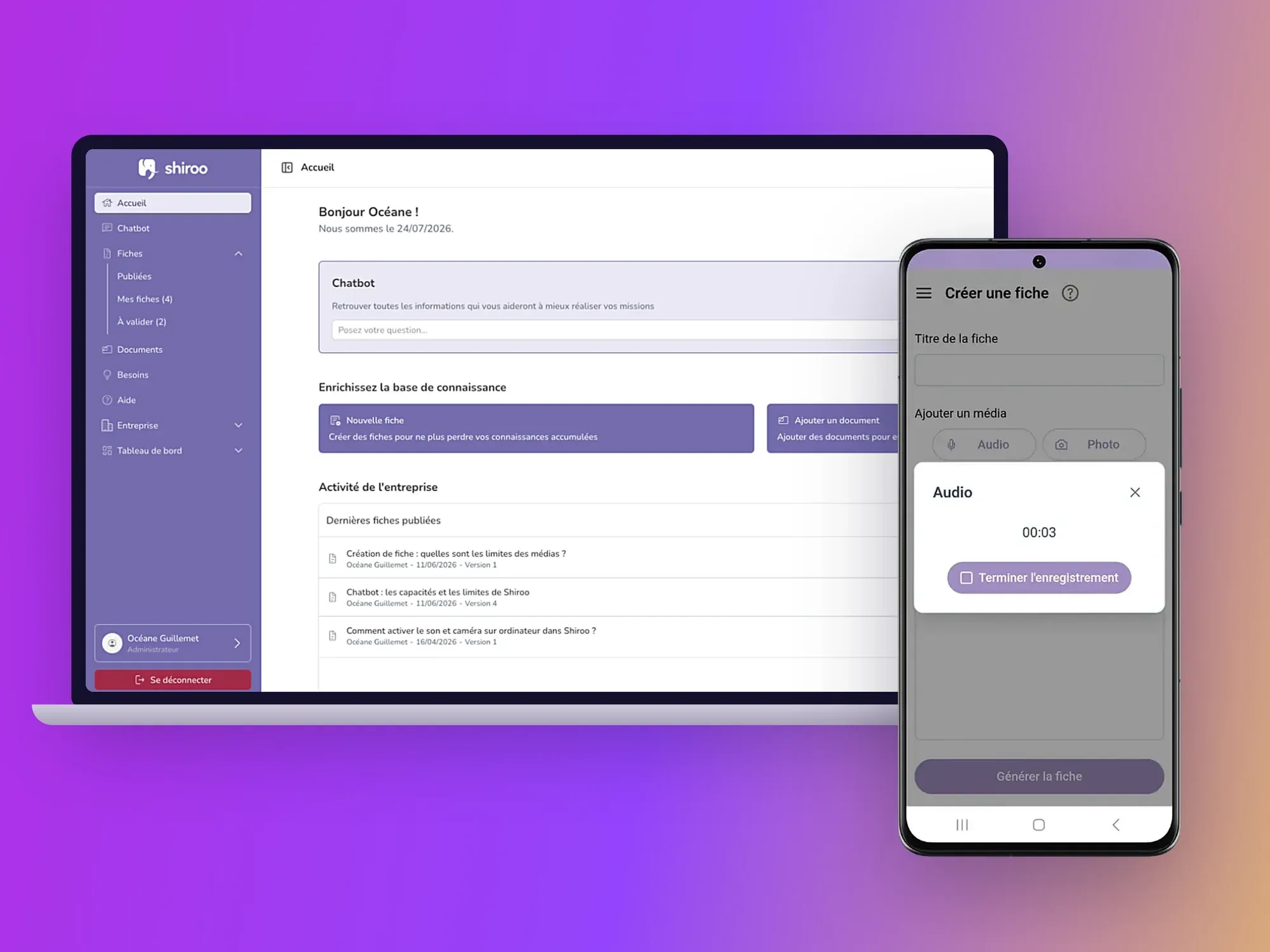
Shiroo, built by Araïko, brings these uses together in a solution designed for manufacturing. Experts explain what they do out loud, take photos or film a job on their phone, and Shiroo turns it into a clear, illustrated work sheet. A subject-matter lead reviews and approves it before it is published. Teams then find that know-how by asking questions in their own words, on phone, tablet or computer, and get answers with their sources. See how Shiroo works.
Conclusion
Knowledge management is critical for manufacturing: it improves performance, makes operations safer and supports innovation. As technology moves fast, AI offers practical ways to structure and share information. Tools like Shiroo go further by making shop-floor know-how easy to document and giving instant access to each company’s own knowledge. Investing in them is a strategic move for manufacturers that want to last and stay competitive. Request a demo to see Shiroo on your own use cases.