
Knowledge is one of the invisible pillars of any company. It flows through informal conversations, gets written down in documents and lives in people’s job expertise. Yet without a method or framework, that knowledge tends to scatter, or to disappear when people leave, teams change or tools evolve.
That is why enterprise knowledge management exists. It goes beyond archiving and documentation. Its aim is to structure knowledge, make it accessible and keep it alive in everyday work.
With hybrid work, the rise of AI and increasingly complex industrial environments, knowledge management is taking on a new dimension. It has become strategic. It makes teams more agile, processes more reliable and innovation faster.
What is enterprise knowledge management?
To manage what you know, you first need to understand what knowledge is, how it shows up in a company and why it deserves attention. Knowledge management rests on clear but often underestimated foundations. Here are the key concepts.
A clear definition of knowledge management
Knowledge management is the set of practices that identify, structure, share and leverage the knowledge an organization relies on. It covers technical data, field experience and job know-how, and more broadly everything that helps a company run, improve and adapt.
It is not just about creating shared folders or internal manuals. The goal is to get the right knowledge to the right people at the right time. It concerns every level of the company, from leadership to frontline teams.
What is a knowledge management model?
A bit of history. Several models have shaped thinking about knowledge management. One of the best known is the SECI model, developed by Nonaka and Takeuchi. It identifies four main dynamics:
- socialization, which enables knowledge sharing of tacit knowledge between people;
- externalization, which turns that knowledge into documented content;
- combination, which brings together explicit knowledge that already exists;
- internalization, which puts that content back into daily practice.
This cycle shows that knowledge management is never static. It is a continuous process in which knowledge is built, exchanged and enriched. Storing information is not enough: you also have to create the conditions for it to spread and be put to use.
Sharing culture, digital tools and the learning organization
No knowledge management effort works without a culture of sharing. That means trusting people, encouraging them to pass on what they know and recognizing their contributions. Without that mindset, even the best tools fall flat.
Digital tools support this culture. They provide spaces to collaborate, platforms to document and engines to find information. But they do not replace people. They support them, structure the flow of information and make knowledge easier to reach.
A company that manages its knowledge well is usually a learning organization. It builds on experience, learns from its mistakes and adjusts its practices. It becomes more agile and resilient while strengthening its in-house skills.
What is specific to manufacturing
In manufacturing, knowledge management is even more critical. Knowledge is often technical, specialized and hard to put into words. It is built over years, working with machines, processes and the realities of the shop floor.
Losing an expert or an experienced technician can weaken an entire production line. Regulatory requirements, traceability and audits make documentation even more essential. And new technologies demand that skills be updated constantly.
In this context, knowledge management becomes a lever for both performance and safety. It ensures continuity, supports innovation and lets the company build on collective experience instead of starting over with every change.
What types of knowledge does a company need to manage?
Knowledge comes in many forms. In a company, it can be written, passed on by word of mouth, learned on the job or shared in a casual conversation. To manage it well, you need to understand the different types of knowledge that coexist. Each has its own characteristics, challenges and ways to make the most of it.
Explicit vs. tacit knowledge
The first major distinction is between explicit and tacit knowledge.
Explicit knowledge is documented. It is content you can read, look up and pass on easily: a manual, a procedure, a product sheet or a database. It is accessible, documented and structured.
Tacit knowledge, on the other hand, comes from experience. It is often intuitive, unwritten and hard to put into words. It might be know-how built up over time, a reflex in a tricky situation or a knack for a particular task. This knowledge is valuable, but it can easily be lost if nobody identifies it and passes it on.
The challenge of knowledge management is to bring that tacit knowledge to the surface so it can feed collective intelligence, even when it cannot be documented right away.
Individual vs. collective knowledge
Another important distinction is between individual and collective knowledge.
Individual knowledge belongs to one person. It rests on their skills, experience and learning. It is often subjective, shaped by a unique career path.
Collective knowledge is built through interaction. It comes from a team, a department, a network. It is rooted in work habits, shared processes and joint projects.
To perform well, a company has to be able to turn individual knowledge into shared knowledge without losing anything along the way.
Formal vs. informal knowledge
It is tempting to think everything can be written down and stored. In reality, much of the useful knowledge travels informally: a conversation between coworkers, a quick tip, a story shared in a meeting.
Formal information (reports, procedures, guides) matters, because it is easy to find and standardize. But it is not enough. Informal information, while more fleeting, is often rich in meaning and grounded in the reality of the shop floor.
Knowledge management builds bridges between these two worlds. The point is not to write everything down but to capture what matters, keep a record when it makes sense and encourage sharing, even outside official channels.
Why does knowledge management matter for a company?
In an unstable environment, where skills change fast and information is scattered, a company’s performance depends on how well it manages what it already knows. This goes far beyond technical documentation or a few shared folders. It is about protecting an often invisible but decisive asset: knowledge.
The risks of unmanaged knowledge
Without a clear knowledge management strategy, companies are exposed on several fronts.
The most obvious is lost information. When an employee leaves without passing on what they know, years of experience can vanish. That gap can lead to mistakes, delays or lower quality.
Another common risk is duplicated effort. Without a central system, teams reinvent the wheel, repeat the same analyses and answer the same questions over and over. That hurts efficiency, wears teams out and slows projects down.
Finally, there is dependence on a few key people. If expertise sits with only a handful of employees, the organization is vulnerable. Knowledge management reduces that dependence by spreading knowledge and helping others build their skills.
Faster onboarding and ongoing learning
Bringing in new talent is always a challenge. They need the essentials quickly, without being overwhelmed. A company that manages its knowledge well has clear, accessible, up-to-date content, which makes onboarding smoother.
Beyond onboarding, knowledge management supports continuous learning. It helps employees become more autonomous, progress at their own pace and learn from real cases drawn from the company’s experience. That builds skills and motivation over the long term.
Preserving critical know-how in manufacturing
In industrial settings, knowledge is often specific, technical and hard to capture. It might be a manufacturing protocol, a precise setting, a lesson learned from a breakdown or know-how passed on by word of mouth.
This knowledge is valuable. Yet it is often poorly documented, poorly shared or simply forgotten when the expert leaves. Knowledge management preserves it by documenting best practices, encouraging sharing and building a living company memory.
This approach makes operations safer and strengthens the ability to train new people, even for highly technical jobs.
Fueling innovation, cross-team work and knowledge capture
Knowledge is not just for repeating what works. It can also fuel creativity, fresh thinking and continuous improvement. When it flows between teams, departments or sites, it breaks down barriers and opens new perspectives.
A company that values lessons learned, learns from its mistakes and connects its experts is better equipped to innovate from what it already knows. That is what separates an organization that adapts from one that stands still.
Knowledge management is therefore also a tool for transformation. It helps capture experience, structure learning and keep improving practices.
How can AI improve knowledge management?
Setting up effective knowledge management takes time, resources and real commitment. In many companies, it remains hard to get started. Artificial intelligence removes several of the obstacles, with concrete and lasting solutions.
What makes knowledge management hard?
Even in the most motivated organizations, knowledge management runs into familiar roadblocks. Lack of time is one of the most common. Teams are focused on their daily goals, and documenting what they do often takes a back seat.
There is also the mental load of juggling too many tools. Everyone stores documents in a different place, information is scattered and it becomes hard to know where to look.
Another difficulty is unclear ownership. Should every employee document their work? Should managers centralize it? Should HR coordinate? Without a clear process, the effort quickly runs out of steam.
These obstacles are not inevitable. AI can now reduce the human workload while keeping knowledge management structured, living and scalable.
AI for documenting, searching and sharing knowledge
Artificial intelligence does not replace people. It supports them. In knowledge management, it acts as a quiet enabler.
First, it removes the writing hurdle. An expert no longer needs an hour to write up a procedure: they explain the task out loud, and AI turns it into a structured document they only need to review and correct.
Second, it makes information easier to reach. With natural-language search, employees no longer need the right keyword or folder. They ask their question in their own words and get an answer drawn from the company’s content.
Finally, it helps knowledge spread, by making the same information available to everyone, on the shop floor and in the office, on a phone or a computer.
Reliable knowledge: the role of human validation
A knowledge base is only valuable if people can trust it. AI speeds up documentation, but people guarantee that the content is accurate. That is why a clear validation workflow matters: a subject-matter referent reviews each knowledge sheet before it is published, and every answer links back to its source so people can check before they act.
With that combination, knowledge does not sit idle on a server. It flows, evolves and becomes an active part of daily work.
The Shiroo example: capturing expertise, saving time and making information reliable
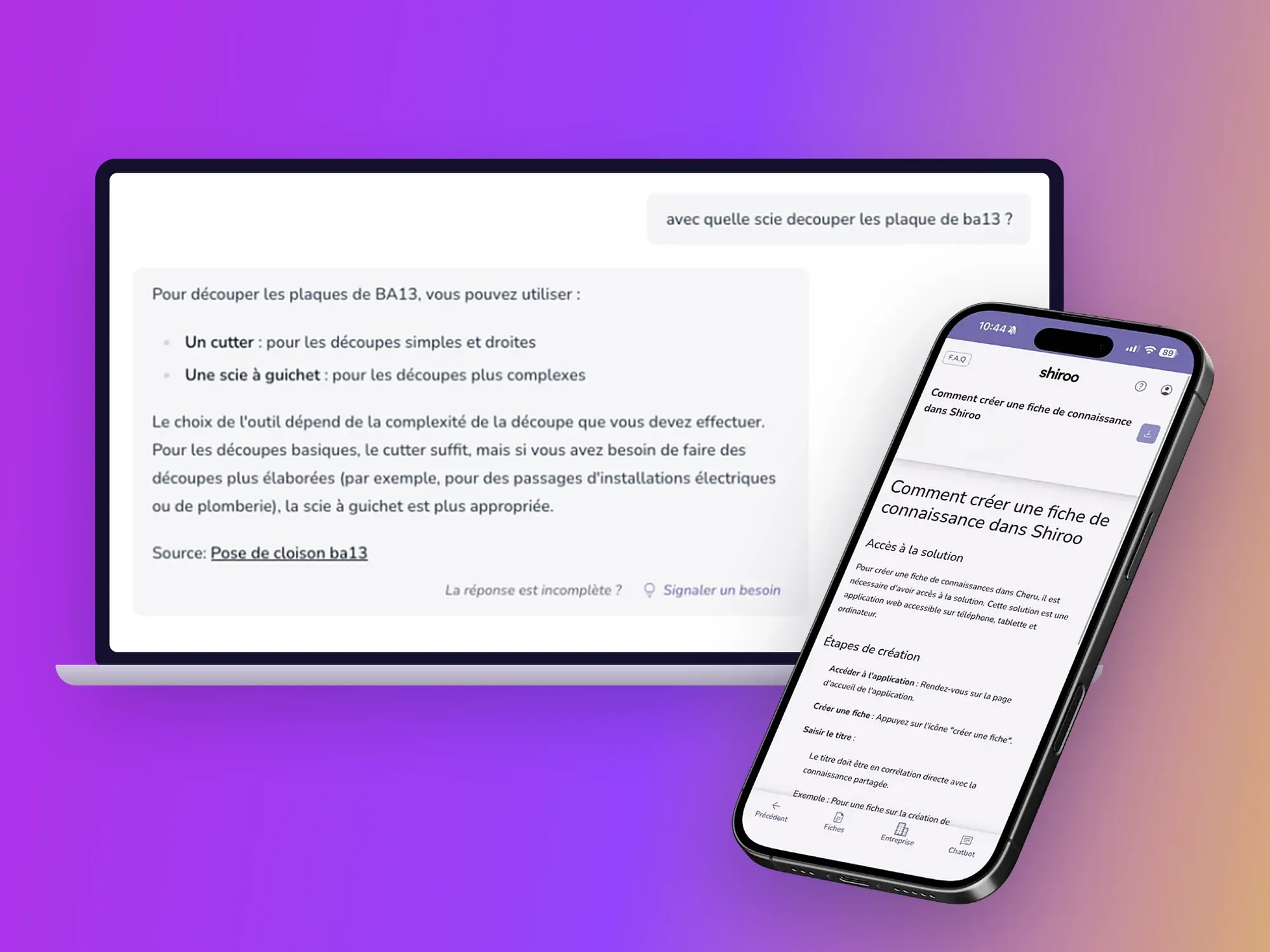
That is why Shiroo was created. It offers a new approach to knowledge management, built on artificial intelligence and ease of use.
On the shop floor, an employee explains a task out loud, takes photos or records a video on their phone. Shiroo turns it into a clear, illustrated, editable knowledge sheet, which a subject-matter referent validates before it is published. Existing documents, such as PDF procedures or manuals, can be imported too, so they become searchable.
Teams save time because they no longer have to hunt for information: they ask Shiroo in their own words, on a phone, tablet or computer, and get a sourced, verifiable answer. They can also document what they know without having to write it up.
Knowledge becomes accessible, reliable and genuinely useful. Shiroo does not replace human knowledge management. It amplifies it, removing friction and putting each person’s expertise where it is needed, when it is needed. Want to learn more before getting started? Request a demo and talk with our team.
Knowledge management, a driver of lasting performance
Every company has unique knowledge. It is built through projects, conversations, successes and setbacks. Yet that knowledge is often underused, scattered or hard to pass on. Enterprise knowledge management makes it possible to leverage it, share it and put it to work at every level of the organization.
With increasingly complex work environments, fast-changing skills and the challenge of passing know-how on, this approach becomes a real performance driver. It supports learning, makes innovation easier and strengthens knowledge transfer, especially in manufacturing.
Artificial intelligence now offers concrete ways to simplify knowledge management without adding red tape. Tools like Shiroo show that you can capture expertise, organize knowledge and make it easy to reach every day.