Every company rests on a common foundation, often invisible but essential: knowledge. It gets passed on, it evolves, and sometimes it gets lost. In a world where data flows nonstop, teams change and information has become a strategic asset, managing it well is a priority. That is where knowledge management comes in.
Behind the term lies a clear ambition: organize, capture and leverage knowledge to turn it into a performance driver.
With the rise of artificial intelligence and automation tools, knowledge management is taking on a new dimension. It is no longer limited to databases or internal procedures. It is becoming living, collaborative and proactive.
In this article, we look at the definition of knowledge management and its components, and at its central role in today’s companies, especially in manufacturing. Along the way, we show how solutions like Shiroo help unlock its full potential.
What is knowledge management?
Before talking about tools, methods or artificial intelligence, let’s go back to basics. What is knowledge management, and why has it become essential for companies? To answer that, we first need a clear definition.
What is the definition of knowledge management?
Knowledge management is the set of practices that identify, organize, store and share the knowledge a company needs to run smoothly. That can include technical data, internal procedures, lessons learned or job-specific expertise.
This knowledge can be formal, like documents or guides, or informal, like the skills an employee has built up over the years. The point of knowledge management is to keep that knowledge from getting lost, and instead to keep it moving and alive across the whole organization.
From individual memory to company memory
Every employee carries a unique body of knowledge. Yet without a way to pass it on, that knowledge often stays locked in one job or one person’s experience. An effective company is one that turns this individual wealth into a collective memory, available to everyone, at any time.
Knowledge management acts as a bridge. It structures information so it is useful, clear and easy to share. By pulling together what each person knows, it creates a collaborative dynamic where expertise no longer depends on a single person but becomes a shared asset.
How knowledge management is changing in the digital age
Knowledge management has been around for a long time, but it is accelerating like never before. Digital technology makes it possible to map what people know and keep enriching it, and above all to make it available at the right time, to the right person.
Artificial intelligence is also reshaping the practice. It takes on the most time-consuming tasks: turning a spoken explanation into a clean document, filing content, finding the right information in a mass of files. Employees no longer need the right keyword or the right folder: they simply ask their question in their own words.
Platforms like Shiroo belong to this new era. They give companies the tools to structure and maintain their knowledge base. It is no longer just a matter of internal organization but a real strategic advantage, for agility, performance and resilience. Explore our Shiroo use cases to dig deeper.
What is the most precise definition of knowledge management?
The term “knowledge management” covers much more than a well-organized document library. To understand it, it helps to look at the word “management” itself, and at what it means when applied to knowledge.
What is a simple definition of management?
Traditionally, management is the art of steering an organization or a team toward its goals. It combines planning, coordination and decision-making. In knowledge management, that same logic applies to something else entirely: knowledge.
Here, you are not managing people but flows of information, expertise and learning. The goal is to understand how knowledge gets shared, how it moves, where it is created and how it turns into value. Knowledge management becomes an invisible but essential form of management, one that structures an organization’s intangible capital.
Steering knowledge
Steering knowledge is not just about storing documents. It takes a strategic vision, alignment with business needs and clear processes to keep knowledge alive day to day.
Knowledge management generally rests on several pillars:
- identifying key knowledge, often scattered;
- documenting it, so it is accessible and understandable;
- sharing it, so everyone benefits at the right moment;
- and maintaining it continuously, so content stays current, relevant and alive.
This approach relies on a range of digital tools: collaboration platforms, knowledge bases, smart search solutions. All of it has to fit into the company’s daily operations without adding unnecessary complexity.
A discipline at the crossroads of people, technology and culture
Knowledge management is often seen as a technical topic. Yet it is first and foremost about people. They hold the knowledge, pass it on and enrich it. Without their involvement, even the best platform stays empty.
That is why knowledge management is also a matter of company culture. It means creating an environment where sharing knowledge is encouraged, valued and recognized, where collaboration wins over gatekeeping, and where technology supports people instead of replacing them.
This link between people, tools and culture is the heart of knowledge management. The goal is not to impose a method but to build a living, agile ecosystem that evolves with the company’s needs.
From PKM to collaborative knowledge management: easier with AI
Knowledge management is not just for large companies or strategy departments. It often starts at a much more personal level, sometimes without people even noticing. This is called PKM, or Personal Knowledge Management. When it is properly connected to the collective level, it can deeply change how a company organizes what it knows. AI makes that transition even smoother.
What does PKM (Personal Knowledge Management) mean?
PKM is the way a person organizes, selects, retains and uses the information they receive every day. It can involve note-taking, calendar management, filing software or monitoring tools. Everyone develops, often unconsciously, their own way of handling the constant flow of information.
PKM is not just about storing data but about doing something useful with it, turning it into practical knowledge. It is a form of intellectual autonomy that helps people learn better, pass things on better and work more efficiently.
How PKM connects to knowledge management at the collective level
If everyone manages their knowledge on their own, silos are bound to form. If, on the other hand, individual knowledge is shared, connected and structured, it feeds a much more powerful common base. That is where collective knowledge management comes in.
Moving from PKM to collaborative knowledge management does not mean erasing individual habits. It means building bridges between personal knowledge and collective intelligence. Good knowledge management encourages sharing while respecting each person’s way of working.
By valuing individual contributions and connecting them to a common framework, the organization becomes more agile, more of a learning organization, and more responsive.
How AI helps move from individual to collective intelligence
Artificial intelligence plays a growing role in this shift from personal to collective. It handles formatting, filing and search without adding to people’s workload. That makes it easier to pool knowledge, even when it is scattered across different tools and formats.
For example, a spoken explanation can become a structured knowledge sheet in minutes, without the expert writing a line. And a colleague can find that sheet by asking a question in plain language, even if they do not use the same words as its author. AI becomes a quiet enabler that helps turn individual know-how into a shared resource.
With these technologies, knowledge management is no longer extra work for teams. It fits naturally into everyone’s day.
The Shiroo example: easier capture, validation and sharing of know-how
This is exactly what Shiroo offers. The platform starts from a simple idea: the knowledge already exists, but it is often in experts’ heads, scattered or hard to reach.
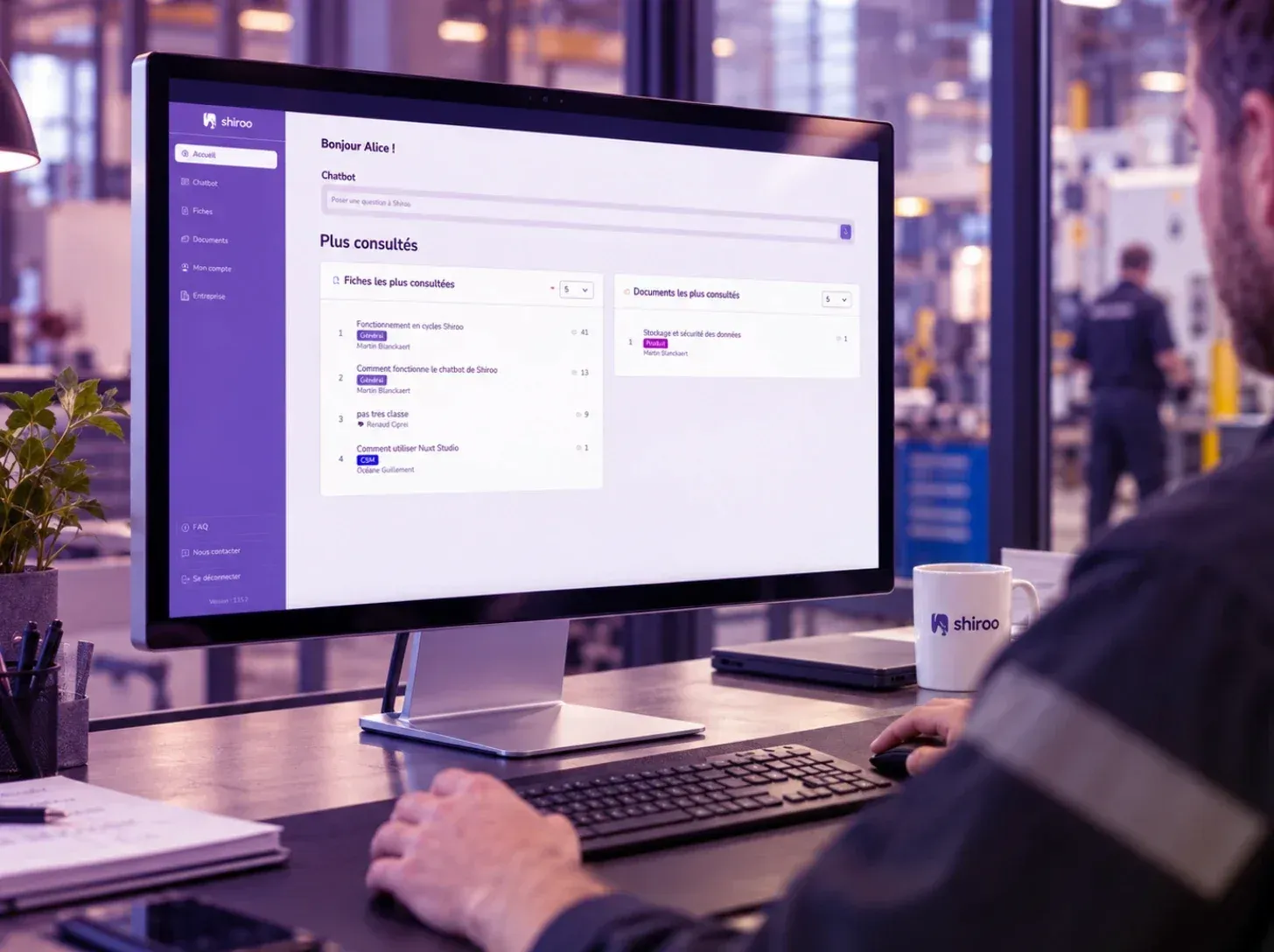
On the shop floor, an employee explains a task out loud, takes photos or records a video on their phone. Shiroo’s AI turns it into a clear, structured, editable knowledge sheet, which a subject-matter referent reviews and validates before it is published. Existing documents, such as PDF procedures or manuals, can be imported too.
Anyone can then find the information by asking a question in their own words, on a phone, tablet or computer. The assistant answers from the company’s own content and cites its source, so people can check before they act.
In short, Shiroo turns knowledge into action. It connects individual habits to a collective approach, with tools built to make teams’ lives simpler, not more complicated.
Why knowledge management drives performance in manufacturing and beyond
Setting up effective knowledge management is not just a good intention or a quality initiative. It is a strategic choice. When organizations need to become more agile, secure their knowledge and pass it on faster, knowledge management becomes a real strategic lever, especially in manufacturing, but not only there.
Breaking down silos and preventing the loss of key information
In many companies, information struggles to move between departments. Each one has its own tools, habits and references. Working in silos slows down communication, delays decisions and can lead to the loss of valuable information.
Knowledge management keeps knowledge flowing by creating a centralized, collaborative environment. Teams find what they need more easily, without searching through ten different tools or constantly asking the same people.
Pooling knowledge also reduces duplication and mistakes. Key information is no longer lost when someone leaves or changes teams. It is structured, captured and available at any time.
Better ongoing training and onboarding
Learning fast is now a competitive advantage. To train people well, you need the right content at the right time. A company that manages its knowledge effectively has a solid foundation for its continuous training programs.
Knowledge management makes onboarding easier. Instead of learning everything by word of mouth or starting from scratch, new hires can rely on living documentation, real cases and lessons learned. They get up to speed faster and gain autonomy.
For existing employees, shared content helps them stay current, deepen their expertise and keep growing over time.
Improving processes and innovating through knowledge flow
Every project, every customer, every incident is a chance to learn. But if those experiences are not documented or shared, only a handful of people benefit. Knowledge management turns experience into a resource, so best practices spread, get reused and feed continuous improvement.
This dynamic also fuels innovation. When ideas connect, when feedback from the floor reaches decision-makers and when knowledge flows freely, it becomes easier to innovate from what already exists: adjusting a product, improving a process or fixing a recurring problem.
In manufacturing, where every mistake can be costly, this ability to learn as a group is a real asset.
Why knowledge management matters for every company
Managing knowledge well is no longer a luxury or a side project. It is a necessity. In a world where everything moves fast, skills keep changing and information travels at high speed, organizing, preserving and sharing knowledge has become essential.
Knowledge management is much more than a filing system: it is a living practice. It connects people, structures exchanges, values experience and fuels collective learning. With the help of artificial intelligence, solutions like Shiroo make it smoother, more effective and, above all, accessible to everyone.
Want to see how it works with your own know-how? Request a demo.