
Information moves through a company all the time: by email, in meetings, in shared documents or in a quick hallway chat. Yet despite the growing number of digital tools, it is often poorly organized, poorly passed on or hard to find.
When information does not reach the right people at the right time, the consequences are real: slower decisions, misaligned projects, wasted time and even internal friction.
Making information flow more easily is therefore much more than a communication issue. It is essential to working more efficiently, encouraging knowledge sharing and collaboration, and strengthening collective intelligence.
Understanding how information flows in a company
Before improving how information is shared, you need to know how it actually moves. Between formal and informal exchanges, digital tools and communication habits, there are many flows, and how well they work depends on many factors.
What do we mean by “information flow”?
Information flow is the set of exchanges that give employees access to the data they need to work: instructions, lessons learned, goals, performance indicators and technical documents.
It involves every level of the company, from the executive team to the shop floor. Good information flow is not just about passing information along: it has to be understood, put in context and usable. Then it creates consistency, reduces misunderstandings and strengthens collaboration.
How does information move through a company?
Information travels through different channels, and it is worth telling them apart.
Formal channels are set up by the company: team meetings, internal memos, newsletters, project management platforms. They structure exchanges around clear processes.
Informal channels rely on spontaneous interactions: hallway conversations, quick calls, instant messages. They keep day-to-day work running smoothly, but they can leave people out if the information is not shared more widely afterward.
Digital channels have become essential: messaging apps, intranets, collaboration tools, databases and knowledge management solutions. Used well, they make sharing easier. Managed poorly, they bury people in information.
What blocks the flow
Even with the best tools, some companies struggle to keep information moving. A few obstacles come up again and again.
Organizational silos are one of the biggest. Some departments work in isolation, with their own rules, tools and habits. Information does not cross from one team to another, which creates duplication and blind spots.
Information overload is another common problem. People receive too many messages, often with no sense of priority. They no longer know what matters or where to find what they need.
Finally, lack of clarity gets in the way of understanding. Information that is poorly worded, too technical or out of context creates more confusion than it solves.
Why has it become strategic?
As exchanges speed up and projects grow more complex, information flow is no longer just an internal communication topic. It is a strategic lever.
A company that can share information quickly, clearly and with the right people makes better decisions. It reduces errors and improves coordination between teams.
It is also about people’s performance: well-informed employees are more autonomous, more engaged and better prepared for the unexpected.
Finally, digital tools open up new opportunities. To make the most of them, you have to rethink how information is structured, shared and made available at the right time.
How to get information flowing in your company
For information to really flow, adding more channels is not enough. You need the right conditions: a culture that supports sharing, clear communication rules and daily practices that make exchanges meaningful.
Build an environment that encourages sharing
It all starts with people. If employees do not feel trusted, or fear being judged or ignored, they share less. An open culture, on the other hand, encourages transparency, mutual support and a natural flow of information.
Managers play a key role here. A manager who keeps the team informed, listens to feedback and recognizes initiative creates fertile ground. Everyday behavior often determines the quality of exchanges.
Encouraging cross-functional collaboration, breaking down silos and inviting people to speak up also help create a climate where information moves more freely.
Structure exchanges with clear processes and the right tools
Information cannot rely on informal exchanges alone. To be effective, it also needs defined processes that prevent omissions, duplication and misunderstandings.
Defining who shares what, with whom and when brings clarity. A clear approval workflow for a technical document, or a weekly project update, makes exchanges smoother.
Digital tools should support the process without adding complexity: intranets, collaboration platforms, CRMs, document management tools. Used well, they centralize useful information, structure it and make it accessible to everyone.
The four pillars of effective communication
Effective communication rests on four pillars: listening, clarity, consistency and relevance. Without listening, information flows only one way. Without clarity, it is not understood. Without consistency, it becomes sporadic and unpredictable.
Active listening helps you spot information needs and adjust your messages. Clarity means well-written content, free of unnecessary jargon and suited to its audience.
Consistency prevents gaps: it is better to share less often in a structured way than to flood inboxes. Relevance means tailoring information to its context, because what helps one team does not always help another.
Keeping these pillars in mind ensures information is not lost or distorted, and that it creates real value day to day.
Who is responsible for information flow?
Keeping information moving is a shared responsibility.
Managers are the first relays. They make sure top-down information is understood and bottom-up information gets through. They create time for discussion, adjust messages and connect teams with leadership.
HR helps structure internal messages, share company policies and coordinate tools. It makes sure messages are consistent and accessible to everyone.
Operations teams are at the heart of the flow. They produce, share, comment on and use information every day. Their feedback is invaluable for improving tools, practices and processes.
Good information flow gets these three levels working together toward a common goal: communication that is useful, human and aligned with real needs on the ground.
How to improve your company’s information system
Companies have plenty of tools to store, share and manage information. That alone does not always make an information system truly effective. AI can now change that, by structuring content and making it easier to use.
The limits of traditional systems
Traditional information systems rely on familiar tools: email, intranets, shared drives, Excel spreadsheets, CRMs, ERPs. They are often indispensable, but they have their limits.
When tools are scattered, information becomes hard to find. It travels through several channels with no overall consistency. People have to run multiple searches and switch between interfaces, which wastes time.
Overload is another issue: too many documents, too many messages, not enough prioritization. Employees receive everything but do not know what to read, when, or how to use it.
Finally, much of the content is not relevant or lacks context. The system exists, but it does not really help people decide or improve. It becomes a burden instead of a support.
AI to structure information and make it easy to find
AI turns these systems into real efficiency levers. It does not just store information: it analyzes it, organizes it and brings it up when someone looks for it.
It structures content: rather than letting data pile up, it groups related items, spots duplicates and makes the latest versions easier to reach.
It also changes how people search. Instead of browsing folders, employees ask their question in their own words and get a precise answer drawn from the company’s own content. Useful information arrives right when it is needed, without overload.
Capturing and sharing know-how with Shiroo
Shiroo is a platform built to make knowledge management easier, especially in industrial environments. You can explore its use cases on our website.
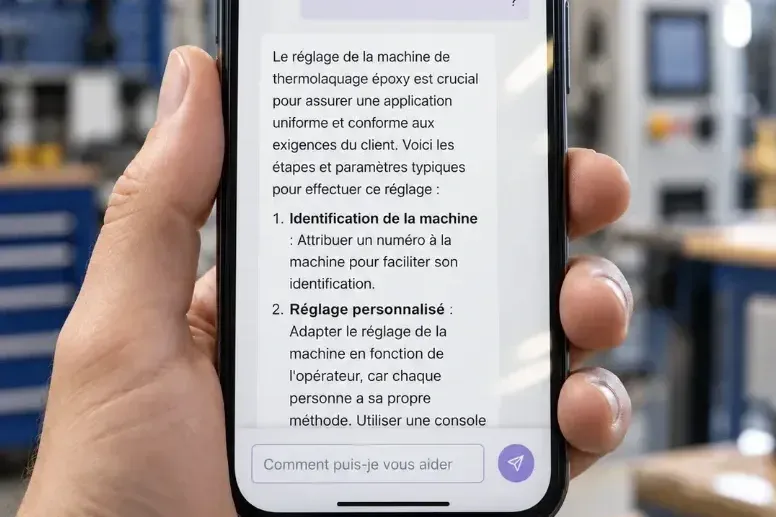
Shiroo tackles the hardest information to share: field know-how, which often only travels by word of mouth. Experts explain their techniques out loud, take photos or record a video from their phone. AI turns that into a clear, illustrated knowledge sheet, reviewed and validated by a subject-matter referent before it is published. Your PDF procedures, technical notices and equipment manuals can also be imported, so they can be searched alongside field knowledge.
Everyone then finds the information on a phone, tablet or computer, or simply asks a question. The assistant answers from the company’s content and cites its sources: an employee starting in a new role finds the right procedure or the relevant lesson learned on their own, without waiting for someone to pass it on.
This lightens the load on teams while making information more reliable and accessible. To learn more about skills in the workplace, read our article What is skills management in a company?
Toward smarter information flow
With AI, the information system becomes more than technical infrastructure. It becomes a decision-making aid, a learning lever and a catalyst for collective intelligence.
Information no longer sits idle in folders: it is structured, connected and available when it is needed. This changes how companies approach internal communication, project management and knowledge transfer, with a simple logic: less effort, more value.
With solutions like Shiroo, companies move from a fragmented system to a connected one, where information is always useful and always available. To learn more, request a demo.
Information flow should be a priority
Making information flow more easily is not about adding another tool or sending more messages. It is about rethinking how knowledge is shared, passed on and structured, in the service of collective efficiency.
In an increasingly complex environment, what makes the difference is not just access to information, but the ability to keep it alive, connect it and make it useful for everyone.
AI opens new possibilities: lighter processes, more reliable content and the right knowledge within reach of the right people, without adding to their mental load.
Solutions like Shiroo show it is possible to build a smooth, people-centered system without sacrificing performance. Because when information flows better, so do ideas, skills and trust.